
The Limits of LinkedIn’s AI Writer
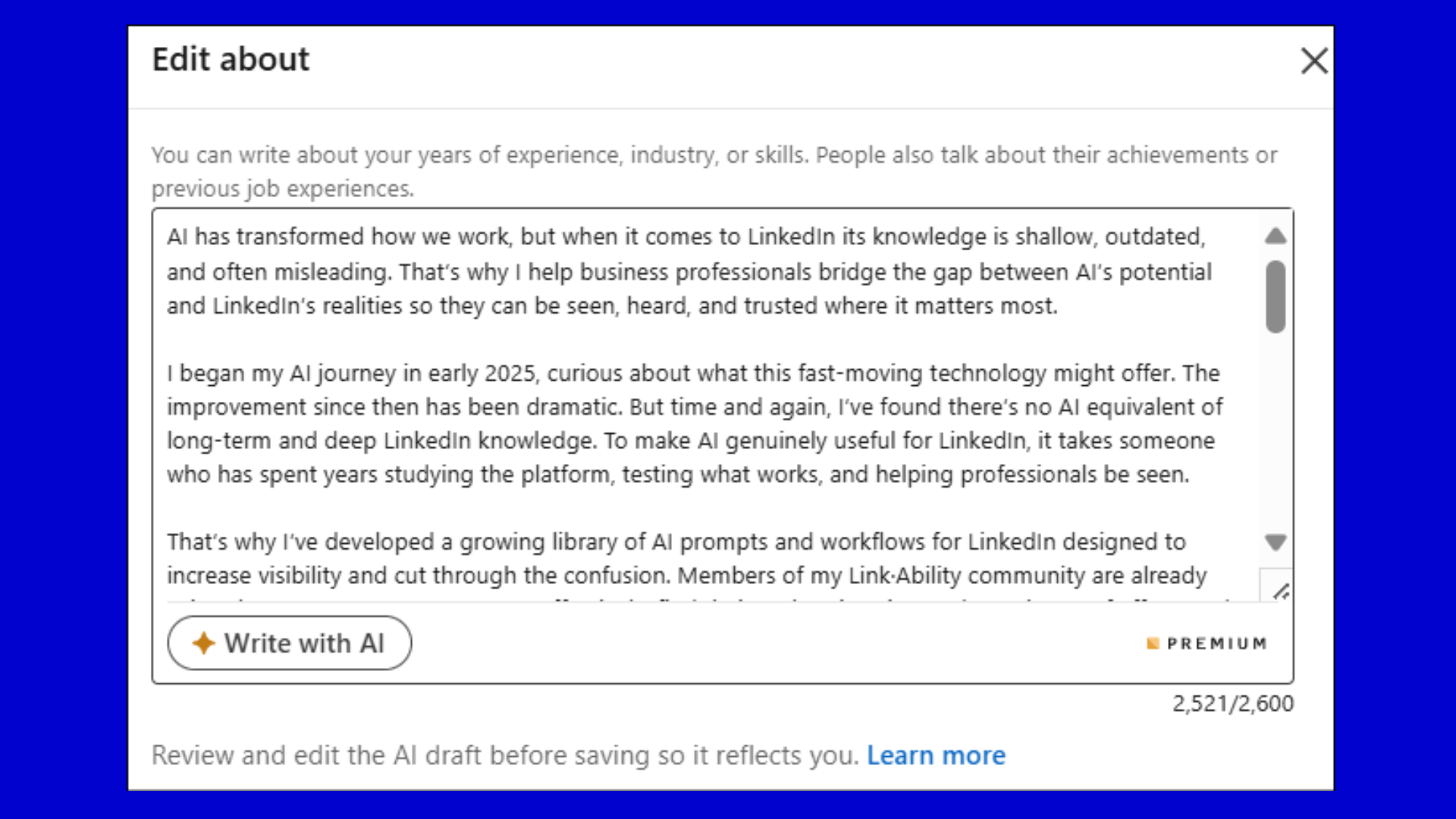
For quite some time, LinkedIn’s Premium account holders have had access to features allowing us to use an inbuilt AI to rewrite the About section of our profiles, generate posts from just a few words and a few other tasks.
But despite LinkedIn being owned by Microsoft which is a key owner of OpenAI, the creator of ChatGPT, this LinkedIn AI writing system has been uniformly awful.
It seemed to have no understanding of best practice and would generate outputs that were far too short. As well, it seemed to understand very little about us and the outputs were generic and lacking detail.
Little has improved in the lengthy time this feature has been available. The reason has now become apparent.
LinkedIn’s “rewrite with AI” feature is designed for speed and consequently has very clear limitations. It cannot learn your voice, reflect your expertise, or tailor content for your audience. It seems likely that until Microsoft’s Copilot integrates more deeply with LinkedIn, this feature remains a blunt tool.
Smarter AI Use
Instead of trying to turn a sow’s ear into a silk purse, we need to be working with AI off LinkedIn rather than on it. But even then, outputs can be very generic.
Recently, we held a livestream with Brynne Tillman, the creator of the CRISPY framework for AI. It’s prompt that not only improves your general AI query outputs but in particular your LinkedIn profile and content outputs.
A strong framework such as this ensures content remains authentic, Here’s what a CRISPY prompt looks like:
- Context – what you are writing and for whom
- Role – the perspective AI should adopt
- Inspiration – examples or past work to mirror
- Scope – boundaries for length and tone
- Prohibitions – what to avoid (e.g. don’t research; use my content)
- You – always ask questions to refine outputs in your voice
From Content Creation to Surfaceability
AI is changing where authority is recognised. Substack, YouTube, Quora, and Reddit are all indexable platforms now feeding generative search. LinkedIn posts alone are not enough because they are not indexed outside the platform. Nor are they discoverable by AI. Only articles and newsletters published on LinkedIn are fully indexable off LinkedIn.
This means we need to build an indexable content strategy that ensures both humans and LLMs can surface our expertise.
Ownership and Risk
Updated terms of service mean LinkedIn content may be used by affiliates, raising content ownership concerns. Leaders should maintain an independent knowledge base – transcripts, articles, and original documents – to preserve their intellectual property.
The Leadership Lesson
AI on LinkedIn is not about replacing your voice. It is about amplifying it. Leaders who use smart prompts, publish indexable content, and protect their intellectual property will be the ones surfaced by both people and AI systems in the years ahead.