
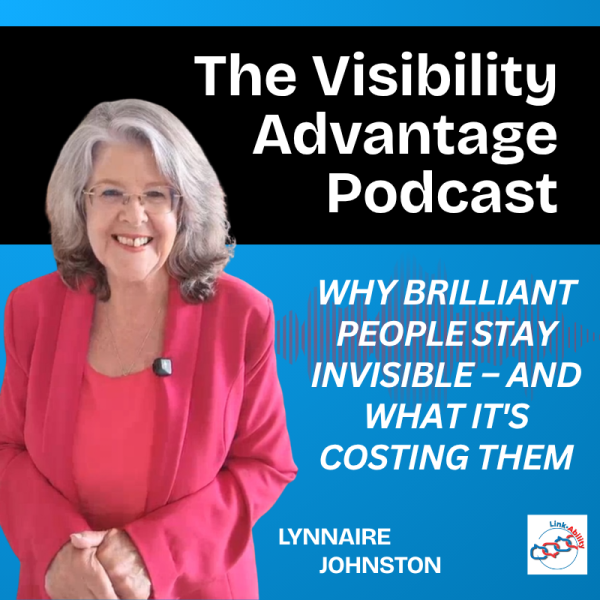
This is an edited extract from Episode 1 of The Visibility Advantage Podcast, the fortnightly show for senior leaders and business owners who want to become as visible as they are valuable. [Listen to the full episode here.]
I want to share something I've observed over nearly a decade of working with senior leaders – mainly in Australia and New Zealand, but across the world.
The most experienced people in a room are often the least visible outside of it.
I'm talking about leaders with thirty years of expertise. People who've built teams, turned businesses around, won industry awards, written books, led organisations through genuine complexity. People their peers respect enormously.
And yet – if you searched for them online, you'd find almost nothing. A LinkedIn profile that reads like a CV from 2015. No thought leadership content. No indication of the depth of what they actually know.
The invisible expert problem
Here's the thing about invisibility: it doesn't feel like a problem. Not at first.
When you're well-established, when your network knows your name, when the phone has always rung – it's easy to assume it always will.
But over the years I've seen the same story play out in different ways for different leaders.
There's the person who's spent thirty years in corporate life and is suddenly, unexpectedly, looking for their next role – and discovers that their LinkedIn profile hasn't been touched since they joined the platform.
There's the person who has deep, genuine expertise in their field – who could be speaking at conferences, advising boards, building a consulting practice – but who has no visible body of work online. And so the invitations go to someone else.
There's the person who has left corporate life and is trying to build something of their own – a consulting practice, a portfolio career, a new advisory role – and who is discovering for the first time that without visibility, it's very hard to build trust with people who haven't met you.
Different situations. Same underlying problem: the world doesn't know they exist.
Three leaders, one lesson
Let me make this concrete with three real stories.
The national sales manager. Upwards of thirty years of experience. An impressive career by any measure – industry awards, large teams led, results delivered at the highest level. When redundancy hit, he had almost nothing to show for it online. His LinkedIn profile was basic. His network was small. Nothing about his online presence reflected his seniority or his expertise.
Within one week of working together to build his executive visibility on LinkedIn, he had been headhunted by a recruiter.
Not because he'd suddenly become more experienced. Not because his skills had changed. But because now, when someone went looking, they could actually find him. And what they found reflected the leader he already was.
The project management executive. She had a mid-level LinkedIn presence but nothing that signalled her real depth of knowledge. We worked together on a single LinkedIn article – one piece of long-form content that genuinely demonstrated her expertise.
That article was indexed by Google and discovered by AI. The right people found it. She was offered a speaking slot at a major industry conference. Her first – but I'm confident, not her last.
One piece of content. One clear demonstration of what she knew. It cemented her standing in her industry in a way that years of simply doing excellent work hadn't managed to do.
The CEO moving to the United States. He had clear leadership skills, a strong track record, and a plan to move to a country where nobody knew him. By optimising his LinkedIn profile to clearly position what he'd done and what he could bring, he was offered a role shortly after arriving.
His LinkedIn presence crossed the ocean before he did. It did the introduction for him.
Three different people. Three different situations. In every case, the thing that changed wasn't their experience – it was their visibility.
What AI has changed about professional discovery
For most of the leaders I work with, professional opportunity has historically come through relationships. Word of mouth. A trusted introduction. Someone in a network recommending a name.
That still matters. But it no longer goes far enough.
When someone today is looking for an expert in your field – a board chair researching candidates, a conference organiser finding speakers, a potential client deciding who to call – they don't just ask around. They search. And increasingly, those searches are being mediated by AI.
AI tools now embedded in LinkedIn, in search engines, and in the way people find and evaluate professionals are indexing your online presence and making judgements about your expertise based on what they find.
If there's nothing there to find, you don't exist. Not because you're not qualified. But because there's no signal for AI to surface.
The question I now ask every leader I work with is this: if someone asked an AI tool to recommend experts in your field right now – would your name come up?
For most senior leaders, the honest answer is no. And that is a problem that is only going to grow.
The Link•Ability Blueprint: four foundations of strategic visibility
This isn't about becoming a content creator. It's not about posting every day or building an audience or becoming someone you're not. It's about having enough of a presence – clear, credible, consistent – that when someone goes looking, they can find you, understand what you do, and trust what they find.
The system I use with every client is built around four foundations. Together, they explain how LinkedIn actually works in the AI era.
Discovery is how LinkedIn – and AI – actually finds you. Most leaders assume visibility comes from posting. It doesn't. Discovery is driven by semantic signals: how clearly your profile communicates your expertise, which topics you're consistently associated with, how your network connects you to the people you want to reach. When your Discovery foundation is strong, the right people find you even when you're not actively doing anything.
Perception is what people – and AI – understand about you in the first few seconds. Your headline, your profile narrative, the immediate story your presence tells. Perception determines whether someone trusts you instantly, whether your expertise is obvious, whether AI can correctly categorise and recommend you. Fixing Perception doesn't require you to reinvent yourself. It requires you to be legible.
Connection is where most people are surprised. LinkedIn is not primarily a content platform – it's a relationship engine. The opportunities that matter come from trust, not follower counts. Connection is built through what I call micro-interactions: the thoughtful comment, the direct message that opens a conversation, the consistent presence in your professional community that means people know, like, trust, and remember you when an opportunity arises.
Momentum is the compounding effect that most leaders never build, because they treat LinkedIn as a one-off exercise rather than a long-term presence. Momentum is what happens when you show up consistently over time – when AI learns your expertise, when your audience grows organically, when your reputation starts to do work you aren't actively doing.
Discovery, Perception, Connection, Momentum. When you understand these four foundations, you stop seeing LinkedIn as a posting platform and start seeing it for what it actually is: a discoverability engine, a clarity engine, a relationship engine, and a momentum engine.
That reframe alone changes everything.
Ready to understand where your visibility stands right now?
The Executive Strategic Visibility Review is a one-off audit that shows you exactly where your presence is right now – what's working, what's missing, and what to address first. Not a generic report. A specific, honest assessment of your situation.
The Visibility Advantage Podcast is a fortnightly show for senior leaders and business owners who want to be as visible as they are valuable. Hosted by Lynnaire Johnston – New Zealand's #1 LinkedIn expert and author of Link•Ability, 4 powerful strategies to maximise your LinkedIn success. [Subscribe wherever you listen to podcasts.]