
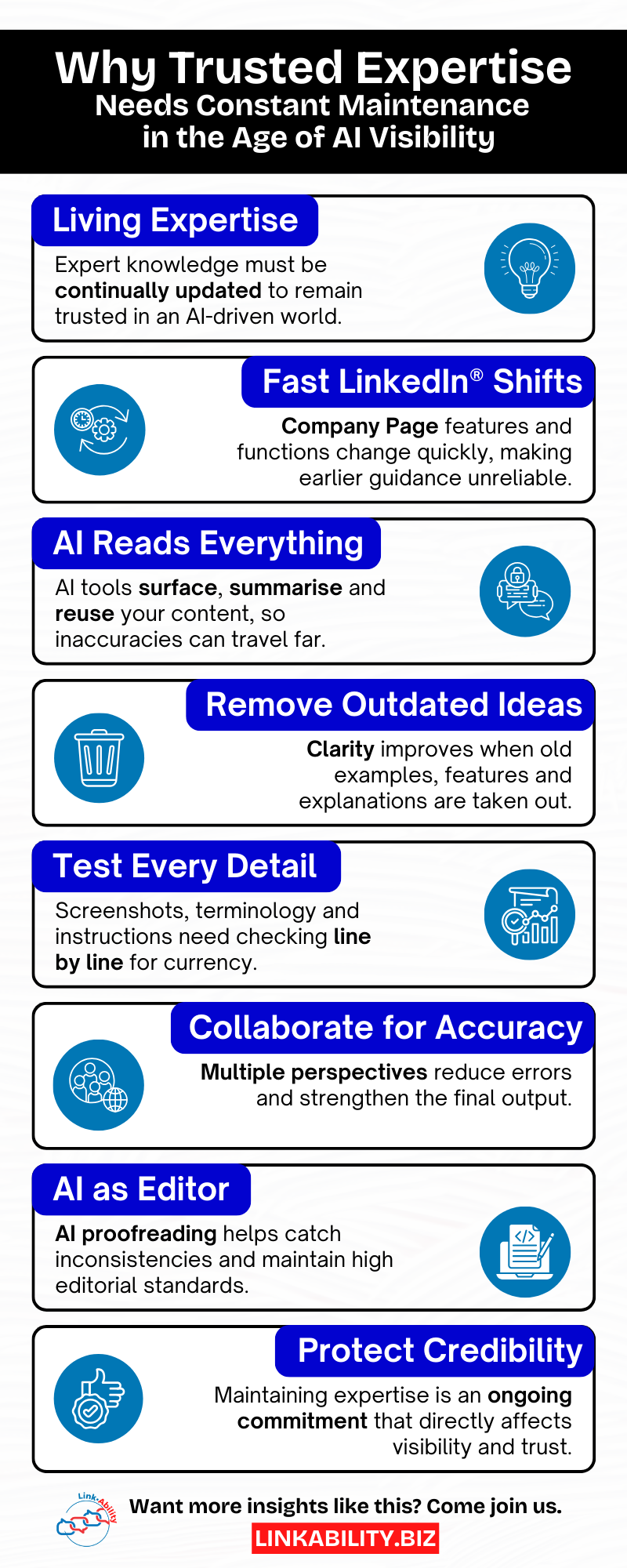
Maintaining Trusted Expertise in the Age of AI Visibility
Expertise used to have a long, comfortable lifespan. You could develop deep knowledge, refine it over time, and rely on it to serve you well for years. But the world has changed. The pace of technological evolution, especially in AI, means expertise ages faster than ever. What leaders shared confidently two years ago may already be outdated. And when people rely on your guidance to make decisions, that gap matters.
This new environment demands a different kind of professional discipline. It requires maintaining trusted expertise rather than assuming expertise remains valid. Leaders must now view their knowledge as a living asset – one that requires care, revision and continuous alignment with the current landscape.
AI Has Redefined How Knowledge Is Interpreted
The introduction of AI into everyday business has reshaped almost everything about how information is consumed. AI models search, read and summarise content far more extensively than humans ever could. They turn years of writing, posting and publishing into patterns that shape how your expertise is understood.
This is where maintaining trusted expertise becomes crucial. Outdated information no longer disappears quietly. It is resurfaced by AI, recommended in summaries, and interpreted as if it were still accurate. Leaders can find themselves represented by versions of their thinking that no longer reflect their best judgement.
In practical terms, this means:
- AI doesn’t know which of your ideas you’ve outgrown
- Old explanations may still be viewed as current
- Inconsistencies can undermine credibility
- Your past digital footprint directly affects your current reputation
Trusted expertise now depends on how consciously you keep your knowledge aligned with the present.
The Leadership Discipline of Updating What You Know
Maintaining trusted expertise is not about chasing every trend or rewriting everything you produce. Instead, it’s about adopting a rhythm of review – a structured approach to checking what is still true, what has changed, and what no longer serves your audience.
There are three elements to this discipline:
1. Review and Remove
Leadership requires letting go of outdated concepts, even those you once championed. Removing old advice is not a sign of inconsistency – it is a sign of integrity. It shows you are committed to accuracy, not ego.
2. Reframe and Refresh
Some knowledge remains fundamentally valid but needs reframing for a new context. AI, new platforms and evolving expectations often require fresh language or clearer structure. Refreshing familiar insights keeps them relevant and respected.
3. Rebuild Where Needed
Occasionally, entire areas of expertise must be rebuilt. This might include new examples, updated frameworks or revised best practices. Leaders who embrace this early avoid playing catch-up later.
This discipline is how expertise stays strong. Without it, even the most impressive knowledge base becomes brittle.
AI Visibility Raises the Standard of Professional Clarity
One of the most powerful implications of AI visibility is how it rewards clarity. AI tools evaluate structure, consistency and topical alignment. They look for clear patterns of expertise. They surface content that demonstrates coherence across posts, articles, comments and longer-form assets.
This means:
- Your content must align with your current areas of expertise
- Contradictory or outdated materials weaken your authority
- Clear, updated explanations help AI interpret your work correctly
- Consistency boosts how easily you are understood by humans and machines
In short, AI visibility makes clarity a competitive advantage.
Collaboration Strengthens Expertise
Even the most experienced leaders benefit from collaborative review. Trusted expertise is rarely built alone. Peers, colleagues, co-authors or mentors can spot assumptions you no longer notice. They can challenge outdated thinking, offer new perspectives and identify gaps that compromise clarity.
Collaboration also helps avoid the very human tendency to see what we expect to see in our own work. Fresh eyes strengthen credibility, and in an era defined by AI interpretation, that strength matters.
AI as a Support Tool, Not a Replacement
AI is more than a challenge – it is also a tool for maintaining trusted expertise. Leaders can use AI to:
- check for inconsistencies
- strengthen clarity
- identify outdated language
- test explanations for accuracy
- ensure terminology matches current standards
Used well, AI becomes a partner in maintaining high editorial quality. It supports your thinking rather than replacing it.
The Future Belongs to Leaders Who Maintain Their Expertise
The leaders who thrive in 2026 and beyond will not be those who know the most. They will be those who maintain their knowledge with clarity, discipline and curiosity. Maintaining trusted expertise is an ongoing process, woven into how you think, communicate and show up professionally.
It is a form of leadership. It signals respect for your audience. And it ensures your authority remains current in a world where AI amplifies whatever you publish.
Expertise is no longer a fixed point. It is something you actively protect.