

Most senior leaders do not have a visibility problem. They have a visibility model problem.
They are operating as if platforms like LinkedIn® are still communication channels – places to share updates, publish content, and maintain a presence.
But that is no longer how visibility works.LinkedIn® has become something far more consequential.
It is now a leadership judgement environment – one increasingly shaped by artificial intelligence, semantic interpretation, and behavioural signals.
And in this environment, visibility is not about activity.
It is about how clearly your leadership can be understood, trusted, and surfaced at the exact moment decisions are being made.
This is why the Link∙Ability Executive Visibility Blueprint exists.
It provides a clear, practical model for how executive presence is now formed in an AI-mediated world – not through tactics, but through four distinct layers of judgement that determine who gets seen, trusted, and selected.
Why Executive Visibility Has Changed
At senior level, opportunity rarely comes from reach. It comes from recognition, trust, and relevance in high-stakes contexts. Board appointments. Advisory roles. Media requests. Strategic introductions.
These decisions are increasingly influenced by systems that interpret:
- what you represent
- where your expertise sits
- how consistently you demonstrate judgement
- and who you are trusted by
In other words, visibility is no longer something you create. It is something that is continuously assessed.
And if that assessment is unclear, incomplete, or inconsistent – you are simply not surfaced.
Not because you lack credibility. But because that credibility is not being correctly interpreted.

The Four Foundations of Executive Visibility
The Executive Visibility Blueprint is built on four foundations. Each one represents a different layer of how both humans and AI evaluate leadership. Together, they form the architecture of modern executive presence.
1. Discoverability – How Leadership Relevance Is Surfaced
Discoverability determines whether you appear at all. Not just in searches – but in recommendations, conversations, and decision-making pathways.
At executive level, this is not about posting more. It is about semantic clarity and topic authority.
- Can AI accurately place you within leadership-level discussions?
- Can your profile clearly signal your role, remit, and domain?
- Are you connected to the right networks where decisions are shaped?
When Discoverability is strong, you are surfaced before outreach is required.
When it is weak, you remain invisible – regardless of capability.

2. Interpretation – How You Are Understood in Seconds
Interpretation is the fastest and most decisive layer. It governs what happens in the first few seconds someone encounters you.
This is where most executive visibility fails.
Not because leaders lack experience – but because their narrative is fragmented, overly complex, or misaligned with their current positioning.
Interpretation answers questions like:
- Are you clearly senior, or does your profile read as operational?
- Is your expertise coherent, or scattered across roles?
- Does your presence align with your level of responsibility?
It also determines whether AI can confidently recommend you in high-trust contexts.
When Interpretation is strong, you are immediately recognised.
When it is weak, you require explanation – and explanation is friction.

3. Relational Authority – Where Opportunity Actually Comes From
Executives are not chosen because they are visible. They are chosen because they are trusted.
Relational Authority is the layer that determines:
- who advocates for you when you are not in the room
- who engages with your thinking publicly
- who includes you in high-trust conversations
This is where LinkedIn® is most misunderstood.
It is not a content platform. It is a relationship environment.
Your visibility is shaped not just by what you publish, but by how you participate:
- the quality of your comments
- the conversations you contribute to
- the people you engage with
These interactions teach both humans and AI who you are relevant to.
And that relevance is what drives opportunity.
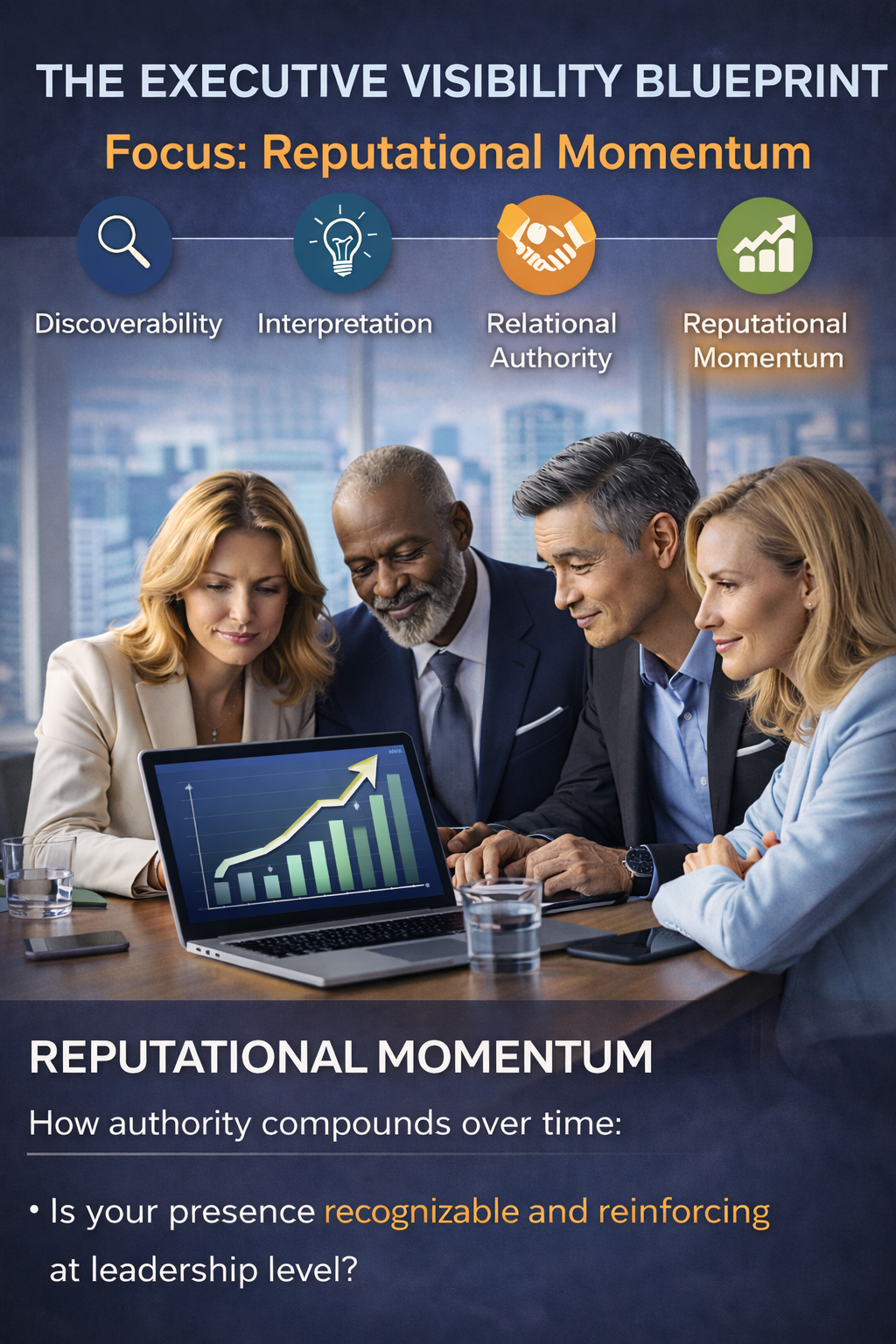
4. Reputational Momentum – How Authority Compounds Over Time
Reputational Momentum is what makes your presence durable. It ensures your credibility strengthens over time rather than fading between moments of activity.
This is not about volume. It is about consistency of signal.
- Are you associated with clear leadership themes?
- Do you show up in aligned conversations over time?
- Is your presence steady, or sporadic and reactive?
AI systems learn from patterns. So do people.
When those patterns are clear and consistent, your authority becomes self-reinforcing.
When they are not, your visibility resets again and again.
Bringing the Blueprint Together
The power of the Executive Visibility Blueprint is not in any one foundation. It is in how they work together.
- Discoverability ensures you are found.
- Interpretation ensures you are understood.
- Relational Authority ensures you are trusted.
- Reputational Momentum ensures you are remembered.
When all four are aligned, LinkedIn® stops being a platform you manage. It becomes an environment that works on your behalf.
- You are surfaced at the right moments.
- Understood at senior speed.
- Trusted before conversations begin.
And increasingly, this is how executive decisions are made.

The Strategic Shift Leaders Need to Make
The mistake many leaders make is treating visibility as optional. Or worse, tactical.
But in an AI-shaped world, visibility is now part of leadership itself.
It influences:
- who is considered
- who is recommended
- who is invited into opportunity
The question is no longer: “Should I be more visible?”
It is: “Does my current visibility accurately reflect my level of leadership?”
Because if it does not, something else is being interpreted in its place.
Final Thought
The Link∙Ability Executive Visibility Blueprint is not about becoming more active.
It is about becoming accurately visible.
When that happens, you do not need to chase opportunity.
You are positioned to be found, understood, and trusted at the moments that matter most.
And that is where executive visibility becomes a strategic advantage – not a communication exercise.