
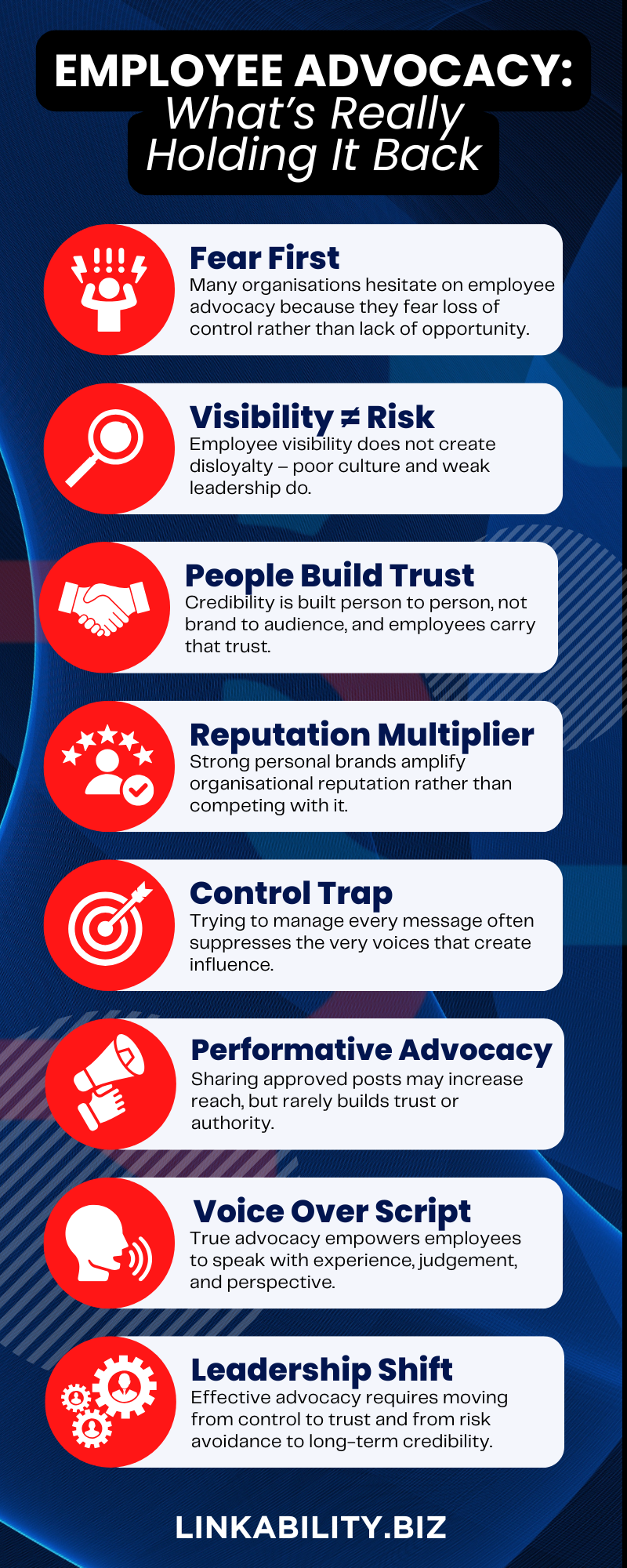
Employee advocacy is widely discussed, frequently encouraged, and rarely implemented well.
On the surface, many organisations claim to support it. In reality, advocacy is often constrained by cautious policies, tightly managed messaging, and unspoken discomfort around employee visibility. The issue is not a lack of tools or platforms. It is fear.
- Fear that visible employees will be headhunted.
- Fear that individual voices will dilute the company brand.
- Fear that control will be lost.
These concerns are understandable. But they are also increasingly out of step with how trust, credibility, and influence are built in professional environments today.
The misconception that employee visibility creates risk
One of the most persistent objections to employee advocacy is the belief that visibility makes employees vulnerable to competitors. The assumption is that if people are known and respected publicly, they are more likely to be recruited away.
This logic misses a critical point.
Visibility does not create disloyalty. Organisational culture does.
If an organisation relies on employee invisibility as a retention strategy, the issue is not advocacy. It is the experience being offered to employees. People stay where they feel valued, trusted, and supported – not where their professional identity is constrained.
Why personal brands strengthen company reputation
Trust is built person to person, not brand to audience.
When employees are recognised as credible, thoughtful professionals, that credibility reflects directly on the organisation they work for. Expertise, judgement, and integrity are human qualities – and they carry far more weight than corporate messaging alone.
Rather than competing with the company brand, individual reputation acts as a multiplier. Organisations with visible, respected employees are more likely to be seen as confident, capable, and connected to their industries.
Suppressing employee visibility may feel protective, but it often creates the opposite effect – distance, anonymity, and reduced relevance.
Strong employee advocacy does not increase turnover. It exposes whether an organisation is worth staying with.
Control is not the same as brand protection
Much resistance to employee advocacy is rooted in traditional, hierarchical thinking. The belief that the brand must speak with one voice, that employees are interchangeable, and that individuality introduces risk still shapes many organisational policies.
This approach no longer reflects reality.
Employees do not arrive without professional identities. They bring experience, networks, perspectives, and reputations shaped over time. Attempting to control or silence those identities does not protect the brand – it weakens engagement and credibility.
Strong brands are built through alignment and trust, not uniformity and silence.
Performative advocacy vs meaningful advocacy
Many employee advocacy programmes fail because they focus on amplification rather than influence.
Encouraging employees to share approved posts or repeat corporate messaging may increase reach, but it rarely builds trust. Audiences can tell when content is performative rather than genuine.
Meaningful employee advocacy looks different:
- Employees communicate in their own voice
- Content reflects professional experience and judgement
- Visibility is based on contribution, not compliance
This approach requires confidence from leadership and a willingness to move beyond rigid control.

The leadership mindset shift employee advocacy requires
Organisations that succeed with employee advocacy make a fundamental shift:
- From control to trust
- From uniformity to individuality
- From short-term risk avoidance to long-term credibility
They understand that while organisations do not own their employees’ reputations, they benefit significantly when those reputations are strong.
The real question for leaders is no longer whether employee visibility carries risk.
It is whether remaining invisible, anonymous, and disconnected poses a far greater one in a world that increasingly values expertise, authenticity, and human connection.
Employee advocacy does not weaken organisations.
Fear does.