
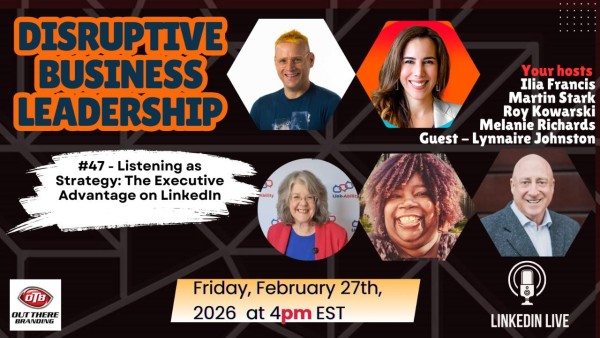
One-Sentence Teaser
Senior leaders discuss why executive listening is a strategic leadership capability and how engaging thoughtfully on LinkedIn strengthens influence, trust, and visibility in the AI era.
Event Teaser
In leadership conversations, listening is often described as a soft skill.
But what if listening is actually one of the most strategic capabilities an executive can develop?
In this Disruptive Business Leadership session, the panel explores why executive listening is becoming more valuable – not less – in an AI-mediated business environment, and how platforms like LinkedIn have changed the way leaders listen, engage, and influence professional conversations.
Signature Insight
Executive listening is not passive.
It is a deliberate leadership behaviour that shapes trust, influence, and decision-making – both inside organisations and in the wider professional community.
What Is Executive Listening?
Executive listening is a leadership capability that involves actively seeking, understanding, and responding to the perspectives of employees, stakeholders, and professional communities.
Unlike operational listening, which focuses on immediate tasks or problems, executive listening focuses on identifying patterns, signals, and insights that influence strategy, culture, and decision-making.
In a digital environment, executive listening also includes observing and engaging in professional conversations on platforms such as LinkedIn®, where leaders can demonstrate curiosity, reflection, and thoughtful participation.
When practised consistently, executive listening strengthens trust, improves decision quality, and enhances leadership credibility.
Key Questions Explored
• Why is listening often misunderstood at executive level?
• What is the difference between operational listening and strategic listening?
• How does LinkedIn change the way leaders listen and engage?
• Why does visible listening strengthen leadership credibility?
• How can executives demonstrate listening in professional conversations online?
Insights from the Discussion
Listening Is a Strategic Leadership Capability
Listening is often described as a soft skill, but the discussion highlighted that effective listening is a strategic leadership behaviour.
Leaders who listen carefully gather insights that shape decisions, relationships, and culture.
Entering conversations with the intention to learn something creates space for new perspectives and stronger outcomes.
Ego Is One of the Biggest Barriers to Listening
Executives often enter meetings with a fixed mindset.
When leaders arrive with predetermined answers rather than curiosity, they stop listening to the people around them.
Setting aside ego and approaching discussions with openness allows leaders to discover insights they might otherwise miss.
Communication Styles Influence How People Are Heard
People interpret communication in different ways.
Understanding communication styles helps leaders recognise how others prefer to communicate.
When executives adapt their communication approach, they become better listeners.
LinkedIn Has Become a Space Where Leaders Listen
Listening no longer happens only in meeting rooms.
Professional conversations increasingly happen in LinkedIn feeds, comment threads, and livestream discussions.
When leaders read posts carefully, respond thoughtfully, and participate in discussions, they demonstrate active listening in a public professional environment.
Authentic Engagement Builds Trust
People respond to authenticity.
When leaders participate in conversations with their own voice rather than delegating posts to marketing teams, audiences feel a stronger connection.
Thoughtful comments, reflections, and questions signal genuine engagement.
Listening Strengthens Influence
Influence begins with being heard.
People feel heard long before they feel persuaded.
When leaders demonstrate that they understand perspectives and reflect them back accurately, they build credibility and trust.
Practical Leadership Takeaways
Enter conversations with curiosity rather than certainty.
Reflect back what you hear to confirm understanding.
Set aside time to listen deliberately to teams and stakeholders.
Participate in professional conversations on LinkedIn by commenting thoughtfully and sharing your perspective.
Approach every conversation with the intention of learning something.
Concepts Referenced in This Discussion
Executive Listening
Strategic Listening
Operational Listening
Leadership Influence
Communication Styles
Trust and Authenticity
Executive Visibility on LinkedIn
AI-mediated professional discovery
Panellists
Lynnaire Johnston
Creator & Community Lead, Link∙Ability
Roy Kowarski
Promotional Product Disruptor
Melanie Richards
Hybrid Event Conversion Strategist
Martin Stark
Commercial and Strategic Leader, Keynote Speaker and Author
Felipe Cofiño
HR Executive, Executive Recruiter and Workplace Culture Developer
Ilia Francis
Video Encouragement Officer specialising in executive video branding
Knowledge Block
Executive listening is the deliberate practice of actively seeking, understanding, and responding to the perspectives of employees, stakeholders, and audiences.
Unlike operational listening, which focuses on immediate tasks and problem-solving, executive listening focuses on understanding broader patterns, ideas, and signals that influence strategy and organisational culture.
In a digital professional environment, executive listening extends beyond internal meetings. It includes observing and engaging with conversations on professional platforms such as LinkedIn, where leaders can demonstrate curiosity, empathy, and openness in public dialogue.
Effective executive listening strengthens trust, improves decision-making, and reinforces leadership credibility.
Transcript
Introduction
This transcript is from a Disruptive Business Leadership conversation exploring the role of executive listening in modern leadership.
The panel discusses why listening is not simply a soft skill but a strategic capability – particularly in an AI-mediated business environment where visibility, influence, and trust increasingly intersect with platforms such as LinkedIn.
The discussion explores how leaders listen to their teams, stakeholders, and audiences online, and why authentic engagement and thoughtful participation in professional conversations are becoming essential leadership behaviours.
Lynnaire Johnston
Today I’d like us to think about listening as a strategy rather than simply a soft skill.
For a long time I assumed listening was something literal – something you do with your ears. But increasingly I see listening as something broader. It can be strategic, deliberate, and visible.
In today’s conversation I’d like us to explore several questions.
Why listening at executive level is often misunderstood.
The difference between operational listening and strategic listening.
Why listening is becoming more valuable – not less – in an AI-mediated environment.
And how LinkedIn changes the context of executive listening.
Listening used to happen mainly in rooms where people spoke and others listened.
Today listening increasingly happens in our feeds.
When we read posts, reflect on ideas, and respond thoughtfully through comments or discussions, we are actively listening in a new environment.
Melanie Richards
I’m delighted that we’re continuing to explore listening as both a concept and a strategy.
When we talk about executive listening it introduces an element of ownership.
It suggests that leaders have skin in the game when it comes to how they show up and how they engage with others.
Executive listening signals that leaders participate in the listening process rather than simply directing it.
Martin Stark
The first and most important point about listening is attention.
Many people want clarity before they’re ready to listen. Their minds are already occupied with their own assumptions or conclusions.
When that happens they stop listening.
Executives often have limited time, so it becomes even more important that they deliberately set aside time to listen and ask questions.
Roy Kowarski
My experience working with executives has taught me that one of the biggest obstacles to listening is ego.
Executives often enter meetings with a fixed mindset.
They already believe they know what the outcome should be.
But if you arrive with a closed mind you are not really listening.
Felipe Cofiño
Over the past thirty years I’ve seen how communication styles influence listening.
Checking your ego at the door is important, but it is only the first step.
Once that happens leaders still need to change how they think and how they communicate.
Understanding communication styles helps leaders hear what people are really saying.
Ilia Francis
Executive listening is about more than acknowledging feedback.
It is about ensuring that feedback is genuinely considered and influences decisions.
Leaders who demonstrate openness and relatability create environments where people feel comfortable contributing ideas.
Final Reflections
Melanie Richards
Show up with curiosity.
Curiosity encourages conversation and reminds people that their perspectives are valued.
Roy Kowarski
Use your experience and knowledge to empower others.
Enter conversations with the intention of helping people grow and succeed.
Felipe Cofiño
Communicate consistently and transparently.
When leaders answer questions openly and share information clearly people know they are being heard.
Ilia Francis
Relatability matters.
Leaders who demonstrate humility and openness create stronger connections with their teams.
Lynnaire Johnston
For leaders who feel they don’t have time to create original content there is a simple starting point.
Repost content that aligns with your expertise and add your own perspective.
Sharing thoughtful insights alongside existing posts allows leaders to participate in meaningful conversations without the pressure of creating everything from scratch.