
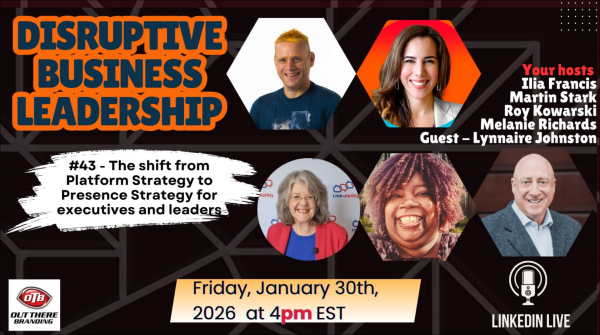
From Platform Strategy to Presence Strategy: How Leaders Are Really Being Discovered Now
A panel of global experts explores how AI, digital ecosystems, and professional thought leadership are changing the way leaders are discovered and understood online.
Signature Insight From This Event
Professional discoverability is shifting from activity on individual platforms to the broader digital presence of a leader’s ideas, insights, and expertise across the online knowledge ecosystem.
Intro Summary
For many years, professional visibility online has been framed as a platform problem. Leaders were encouraged to focus on posting frequency, algorithm changes, and platform tactics in order to remain visible.
But the environment is changing.
As artificial intelligence increasingly shapes how information is discovered and interpreted, professional reputation is no longer determined solely by activity on individual platforms. Instead, visibility is increasingly influenced by how a leader’s ideas and expertise exist across the wider digital ecosystem.
In this Disruptive Business Leadership session, host Lynnaire Johnston is joined by Roy Kowarski, Melanie Richards, Ilia Francis, and Felipe Cofiño to explore what this shift means for senior leaders and professionals seeking to strengthen their influence and authority.
Together they examine the move from platform strategy to presence strategy, and what leaders must understand if they want to remain discoverable in an AI-mediated information environment.
Event Replay
Structured Insight Panel
Topic
How professional discoverability is changing in an AI-driven information landscape.
Core Idea
Visibility is moving beyond individual platforms toward the broader presence of a leader’s ideas across the digital ecosystem.
Why It Matters
AI systems increasingly interpret and surface expertise based on published insights and structured knowledge signals.
Key Takeaway
Leaders must focus on building presence and clarity of thought rather than relying solely on platform activity.
Key Questions Explored
◼ Are leaders focusing too heavily on platforms rather than their broader professional presence?
◼ How are AI tools beginning to influence how expertise is discovered online?
◼ What signals make a professional credible and visible in digital environments?
◼ How do relationships, content, and ideas combine to shape professional reputation?
◼ What practical steps can leaders take to strengthen their discoverability?
Who This Conversation Is For
This discussion will be particularly valuable for:
◼ Senior leaders interested in strengthening their professional visibility
◼ Executives exploring how AI is changing reputation and discoverability
◼ Professionals building thought leadership within their industries
◼ Entrepreneurs and advisors navigating digital influence and credibility
◼ Anyone interested in the future of leadership visibility in an AI-driven world
Key Insights From This Session
Visibility Is Changing
Professional reputation is no longer shaped only by platform activity. It increasingly depends on how ideas and insights are represented across the wider digital ecosystem.
Presence Matters More Than Platforms
Platform tactics alone are not enough. Leaders must develop a broader digital presence that reflects how they think, what they believe, and what they contribute.
AI Is Interpreting Professional Knowledge
AI systems are beginning to interpret leadership insights and frameworks when answering questions about business, careers, and influence.
Thought Leadership Signals Authority
Structured ideas, frameworks, and original commentary create signals that help audiences and AI systems recognise expertise.
Relationships Still Matter
Despite technological change, trust and relationships remain central to influence and leadership credibility.
Key Concepts From This Discussion
Presence Strategy
Presence strategy focuses on how a professional’s ideas, insights, and expertise exist across the digital ecosystem. Rather than concentrating solely on platform activity, it emphasises the visibility of knowledge and perspective.
AI Discoverability
AI discoverability refers to the likelihood that a person’s ideas or expertise will be referenced when artificial intelligence systems generate answers or summaries about a topic.
Executive Visibility
Executive visibility describes the degree to which leaders are recognised, understood, and trusted within professional environments both online and offline.
Thought Leadership Signals
Thought leadership signals are the patterns used by audiences and algorithms to interpret expertise, including frameworks, explanations, and original perspectives.
Digital Knowledge Ecosystem
The digital knowledge ecosystem refers to the interconnected network of platforms, conversations, and resources where professional ideas are shared and interpreted.
About the Speakers
Lynnaire Johnston – Host
Lynnaire Johnston is Creator & Community Lead at Link∙Ability, where she helps professionals and organisations strengthen their LinkedIn® presence and professional visibility in the AI era.
Roy Kowarski – Promotional Product Disruptor
Roy Kowarski helps businesses transform tradeshows into revenue-generating opportunities through smart design, mission-driven merchandise, video brochures, and strategic event frameworks.
Melanie Richards – Hybrid Event Conversion Strategist
Melanie Richards empowers inclusive leaders to cultivate trust and drive team momentum through hybrid events, training, and leadership development focused on engagement and trust.
Ilia Francis – Video Encouragement Officer
Ilia Francis specialises in helping executives and CEOs build personal brands through authentic video communication.
Felipe Cofiño – Executive Recruiter & Coach
Felipe Cofiño is a bilingual bestselling author and LinkedIn Top Voice who works globally as an HR executive, recruiter, and coach focused on leadership and workplace culture.
Knowledge Block – Professional Presence in the AI Era
Professional visibility is evolving as artificial intelligence increasingly mediates how information is discovered and interpreted. In this environment, leadership influence is no longer determined only by activity on individual platforms such as LinkedIn®. Instead, discoverability is shaped by how a professional’s ideas, insights, and contributions exist across the wider digital knowledge ecosystem.
AI systems interpret patterns of expertise by analysing published insights, structured explanations, and thought leadership signals. Professionals who share frameworks, perspectives, and practical insights create knowledge signals that help both human audiences and AI systems understand their expertise.
This shift places greater emphasis on clarity of thinking rather than simple online activity. Leaders who explain ideas clearly, contribute meaningfully to conversations, and document their knowledge publicly are more likely to be recognised as credible sources.
As a result, professional visibility becomes a strategic leadership capability rather than merely a marketing activity. Leaders who develop a thoughtful digital presence increase the likelihood that their expertise will be discovered, understood, and referenced in an increasingly AI-mediated information environment.
Related Resources
◼ Watch the full event replay on YouTube
◼ Executive visibility in the AI era
◼ Building professional presence on LinkedIn®
Quote Highlights From the Conversation
“Visibility today is no longer just about showing up on a platform — it’s about how your ideas exist across the digital ecosystem.”
— Lynnaire Johnston
“The question leaders should be asking is not how often they post, but what signals their thinking is sending.”
— Roy Kowarski
“Video helps leaders show not just expertise, but authenticity and personality.”
— Ilia Francis
“Trust and relationships remain the foundation of influence, even as technology evolves.”
— Melanie Richards
“Recruiters increasingly look for evidence of thought leadership when assessing senior candidates.”
— Felipe Cofiño
Key Takeaways for Leaders
◼ Treat visibility as a leadership capability rather than a marketing task.
◼ Focus on sharing insights and frameworks that clarify how you think.
◼ Build presence across multiple digital environments rather than relying on a single platform.
◼ Document your ideas so they can be discovered and interpreted.
◼ Maintain authenticity and relationships as the foundation of influence.
Full Transcript
Below is the full conversation from the Disruptive Business Leadership session titled From Platform Strategy to Presence Strategy: How Leaders Are Really Being Discovered Now.
The transcript has been lightly edited for readability while preserving the meaning of the discussion. You can also watch the replay above.
[Full transcript follows]
Roy Kowarski
And just like that, we're back. Isn't that the most incredible thing? You wave a magic wand, you click live, and there we are.
Lynnaire Johnston
Kia ora. Hi, everyone.
Nice to be back with you from New Zealand. I haven't been on the show since the end of November when I was able to host from New Zealand.
So it was it was a fabulous one, but that was a while ago now. Roy, is everybody well?
Roy Kowarski
I'm just waiting for the LinkedIn Live to kick in. It's, you know, this new structure that this new sort of format that they've put in place.
You don't just go live anymore. You say go live and then.
Lynnaire Johnston
You can wait till 5 minutes. When we did our live for the first time earlier in the week with the wonderful Melanie Richards, we weren't able to see any comments on the screen.
We don't use Restream, we use String out and we weren't able to see any of the comments at all. So that was a nice little glitch for us to try and find a work around for.
But Mel's really good with those sorts of things and we did in the end find something so that was Right. But even so, I guess it's just a matter of LinkedIn catching up with the on-air bit from the side.
Roy Kowarski
Yeah, that's gone live, you see. It has gone live now.
Lynnaire Johnston
But right from the beginning, I take it.
Roy Kowarski
Right. Well, you see, that's almost two to three minutes before it goes live.
So welcome, everyone. Here we start again.
So as you know, we're very, very fortunate to have our very, very good friend and And Lynnaire joins a month. We have tried desperately.
I've tried to arm wrestle with her, discuss with her husband about how I could get her to come and join us more often. But I do understand.
So this is a special session that we host once a month. And we're very grateful that Lynnaire runs the session for us, provides the topic, and leads the conversation.
So without any further ado, isn't that just one of those famous sayings? Without any further ado, let me present to you.
Lynnaire Johnston
Thank you so much, Mr. Kowalski.
It's a pleasure to be back with you once again in 2026. And today, of course, we're talking about a subject that is top of mind for me at the moment.
As we all know, LinkedIn underwent huge changes towards the end of last year, particularly when we started talking about the new AI engine underpinning it. We all saw a drop in organic reach last year and a number of other not so great engagement or non-engagement signals.
So I've been mulling over that since we became obvious. And I've got a few ideas that I'd like to run by the others in this session, people in our audience as well.
So let me just give you a bit of an overview of my current thinking. And let's see where this takes it.
But I just want to, before I start there, I just want to say that this year marks my 10th year being on LinkedIn. Now, not on LinkedIn as being a LinkedIn member, but really seriously taking it to heart, really working hard on it, and over time becoming a specialist in it.
So as you can imagine, I am a LinkedIn-centric, I love the platform, and most things about it. And so what I'm saying today is quite a departure from my views about LinkedIn over the past few years.
So I'll be interested in your views around this as well as we work our way through it. So with that, let me just explain to you my thinking at the moment.
And it is this. For a long time, visibility has been largely A Google problem.
If you wanted to be found or to be optimized for search and hoped people landed in the right place, you went to Google. But that's no longer the world that we are operating in. the past year, AI's fundamentally changed how we all search, how we ask questions, how we decide who to trust.
Discovery is now happening across platforms, tools, assistance, and recommendation layers, often before someone ever clicks a link or visits your profile. Now, that means two things.
First, discoverability is no longer owned by a single platform, like LinkedIn. LinkedIn matters, of course, but it's only one part of a much wider ecosystem, I'm now thinking.
And 2nd, And this is the part that many people overlook, I think. It's not just about where you show up, it's about what people find when they get there.
Your clarity, your consistency, your signals of credibility, and the story your presence tells across spaces all now plays a role in whether AI and humans surface you at all. So today's conversation is about unpacking that shift.
We'll explore how AI is influencing visibility and discovery, what that means for leaders and businesses who've relied heavily on one platform like LinkedIn, and how to think more deliberately about presence, positioning, and trust across a broader landscape. Now, we'll also dig into some practical considerations.
You know, me, I always like the practical, technical things. So what to pay attention to, what to stop assuming still work, and how to think about visibility as a system rather than a single tactic.
So this isn't about doing more for the sake of it. It's about understanding how discovery now works and making intentional choices about how you show up within it.
And so with that, I'd like to see where you want to take the conversation next, Roy. Would you like to do introductions at this point or shall we move straight on to our topic?
Roy Kowarski
I think an introduction is always a good thing. So why don't you introduce yourself, tell us who you are, what you do, who you serve and what your dream looks like.
Lynnaire Johnston
All right. So my name's Lynnaire Johnston.
I'm the founder of Linkability, the author of a book called Linkability, and co-author of the world's only company pages book, Business Gold. I'm also an executive visibility strategist.
So that means that I help senior leaders to be visible across the internet. And that's become more and more important recently with all the changes that we've been talking about because people are searching in different ways and not just on LinkedIn anymore.
And so I help people to make sure that their presence across multiple platforms is exactly how they would like to appear. So that's me, Roy.
Roy Kowarski
Fantastic. And first of all, let's say that Martin is not feeling well today, so that's why he's not here.
And Mel is not in a Wi-Fi area and she's trying to hotspot the area. So just, yeah, you are, I left with Lynn and myself.
Lynnaire Johnston
That's not a bad combination, Roy.
Roy Kowarski
I think that's a bad combination. The 2 diverse headsets, one without really change the situation.
My name is Roy. I call myself the promotional product disruptor, specializing in trade show preparation.
Now, what does this all mean? It means that companies are very, very, very quick to say, we are ready to go and exhibit at a trade show, to go purchase a stand, and then solves the question, what next?
What should I be doing? And that's what I specialize in.
I assist small to medium-sized companies as well as iconic brands with their trade show preparation. I can work with a small budget, I can work with a large budget, but what it does, it brings everything together, what I do. which is the trade show build, which is the merch, which is the video brochures, which is the structure of how it works, and the most important thing, the strategy to make it work.
So that's what I do. And I might just give a little shout out to my friend Lynette.
She spoke in terms of helping, you know, executives. I regard myself as an executive. many aspects of how I do it, when I do it, why I do it. I'm really grateful, and more importantly, I belong to her LinkAbility membership group.
So that's what I'm all about. I look forward to this conversation, and I'm always happy to, you know, stand and listen and learn and share alongside my friends in there.
Lynnaire Johnston
Thank you, Roy. I think it's fair to say that you probably undersell your LinkedIn presence yourself.
You've been on LinkedIn a long time. You're well known for your Saturday beach videos where you talk about personal development matters, mindfulness and gratitude and other such topics, which I always like to catch because they are a great way to make sure I'm grounded for the week ahead.
And so you and I have a very strong lens around LinkedIn. Now I know you also do, you have a YouTube channel and you are... on Clubhouse too and no doubt other platforms as well.
And I'm the same. I'm LinkedIn centric, do a lot of work with LinkedIn and like you, I do LinkedIn live streams, a lot of content creation.
You and I both got high performing company pages and we do a lot to help others by sharing our information and ideas. Now, for a long time, me particularly, I've been, I've vowed and declared that you could be really successful on LinkedIn.
That through a combination of posting and growing your network and getting to know people, you could be really successful. You could have high visibility levels.
People would see you. It would ripple out into your second degree network.
And people who even weren't active on the platform would find you. Now I don't think that is so much the case.
And I think that's partly because of the new way that LinkedIn is operating and the algorithms that are underpinning the platform these days. And also I think it's the influence of AI has changed all of that.
So as an example, this week I had a discovery call with the owner of a coaching business, and this is an executive coaching business based in a different city in New Zealand from where I am. He and I weren't connected on LinkedIn.
We didn't know each other personally, and I had never heard of this person. And he found me by putting a search into AI.
Now, I came up in the AI overviews. This is on Gemini.
I came up in the AI overviews and on the back of what was put into that, he got in touch. He had not looked at my LinkedIn profile by the time we got on a call.
Now, that tells me that people are not only using AI for search, but they are trusting it. Now, that's fine if what is on there is actually true, but quite a lot of the time, as we both know, AI likes to diplomatically say, fill in the gaps.
And if it doesn't know things about you, or if there are gaps in its knowledge and somebody has asked a specific question, then it will fill them in whether or not it's true or not. And it'll even provide a fictitious link, if you like, so that it can pretend to cite a source that might have absolutely nothing to do with it.
And so I think that what I'd like to do is to talk about how we can be seen across other platforms, how we are being seen across other platforms, what we're doing, what we should be doing, and whether or not we think that LinkedIn is working at the moment. So last year really showed up that we, those of us who post a lot, like Roy and I, were doing well, but we weren't getting the same level of visibility as previously.
And what did come through from that was engagement was a key metric. LinkedIn's given us more metrics in the last year.
We can now see how many people have saved our posts, sent our posts on to other people. Of course, we posted or shared our posts as well.
And how many people have viewed our profile on the back of a post? So a lot more information about how well our posts are doing or not, depending on the circumstances. But what became very clear was that engagement was the key metric.
And a lot of people were saying that they had seen more views on their comments than on their posts themselves. So Roy, let's start from there and tell me what you saw as the most important change on LinkedIn last year as regards visibility. and discoverability for you and your business.
Roy Kowarski
Well, let me say that I've had a specific strategy for quite some time now about making sure that I'm seen, heard and remembered, that I'll show a consistent, here comes Ilia. I'll just let Ilia in.
And just like that, she turns up. Ilia, how are you doing?
Ilia Francis
Hello, can you hear me?
Roy Kowarski
I'm just gonna give you a few minutes to and we're gonna come to you to introduce yourself. So, as you know, Lynnaire, I call myself a participant over a passenger, but what I've discovered. particularly on this last year, is that you can't just stuck in your old ways.
If you don't adapt, you get left in the dust. And dust is not a pleasant thing to eat when you're sitting in the backseat and the dust is pouring in the window.
So I've made a particular note of what are the things that get engagement. And probably the one of the things that I've spent a lot of time on is doing an assessment on my content, is looking at under a microscope.
Because instead of just posting like I've been doing all the years, I'm now saying to myself, let me see if they're new people that are engaging and let me do something about that. Instead of thinking 100 new people, you know, looking at my content, if I get and to start engaging with those people.
Now, that I wanted to throw into the mix. First of all, I have seen of recent how popular and ridiculously popular I do these humorous videos over the holiday period.
Every year, I have a whole library of YouTube videos that bring a little bit of a laugh to people. And you will not how much my engagement over the heart of that period.
And I was not doing the day once a week. That's it.
So people want to be entertained. Number two, people want to have a bit of humor in their lives.
They don't want to read all the serious BS because we can all be serious. They want a little bit of laughter.
They want you to bring a smile to their face. And the other thing that I've discovered is shorter form posts, and I'm not referring to articles.
I'm talking about the content of your post needs to be shorter, clearer, and with a specific message, one message, one post. So those are some of the things that I've addressed.
I'm going to let Mel in. These are some of the things that I've addressed in this new change. And lastly, if I can say, I have leaned into AI, but I haven't lost the human touch.
I've incorporated it, and I've just engaged with someone to help me in my business with HR and with AI to make it more productive, to make it more interesting, to make it more engaging, and to make some changes that can keep me relevant in this AI technical world. Back to you, Lynnaire.
Lynnaire Johnston
Thank you, Roy. And I agree.
Doing an audit of your content is a very good idea. See what works or what doesn't.
Have your AI produce a report for you. That's something that I'm now doing.
Given that we can export our metrics on the back of our posts, it's very easy to have your AI come up with a report about what's doing well over a period of time and what's not. So I think that's It's always a very useful way to analyze what's happened and to do more of what's working and less of what's not.
So before we move on, let's talk to our other lovely ladies, Ilya and Mel, and ask for brief introductions from you both. Ilia, take it away.
Ilia Francis
Thank you so much. I hope that, you know, my voice is loud and clear.
I have a new device, so I'm trying to see whether the setups are still the same. I'm glad to hear that there's a thumbs up.
And thank you, Merill, for the welcome. Hi, Melanie.
I love that, you know, the more we keep it concise, even with technology, with AI or any automation, as long as it speaks to an audience will be fantastic. As long as it is not all about me, about the writer, about the writer, about the writer. And There is a time and a place for it, but always having a way to connect with that person who is reading you with a person who is seeking your content.
You find it, you find the connection, you find the thread, you, know, and then you have a way to either incorporate the automation. in a good way with the human touch. Always, always is, you can't leave it all to the automation unless you are incredibly intelligent and create a human-like side chat that creates emotions, that create relatability, but the human element can't be taken away.
Lynnaire Johnston
Thank you, Ilia. Mel. Would you like to just briefly tell us a bit about yourself?
Mel Richards
Delighted to join you. I'm a hybrid event conversion strategist who helps inclusive leaders and their dynamic teams create conversations at live, virtual, and hybrid events. And I'm certified in trust, so delighted to join you today as we attempt to cultivate trust in our fragile world. fun hanging out with you and toasting you with vitamin water.
Lynnaire Johnston
Good idea. It's morning here, so it's all about the coffee at this stage of the day, probably for Roy and me.
Mel Richards
For myself too.
Lynnaire Johnston
Hard to go past a good coffee. I'd like to mention here just briefly that Mel was on a LinkedIn live with me two days ago on which we talked about trust.
And it was a fascinating conversation. And if you go to my YouTube channel, Linkability NZ, you will find that video there and can catch up with the replay.
It was a really interesting conversation because trust is something that is becoming more and more important as automation takes over. So ladies, we're talking about presence versus platforms today.
And where I'm wanting to take the conversation next is to talk about the fact that discovery of who we are, of what we do, is not confined to one place anymore. Roy and I have already been discussing the fact that we have heavily relied on LinkedIn for the last few years.
And now people are finding us in other places and often using AI. And so it's not about also just the short form posts on LinkedIn.
It's also about the long form thinking that we are able to demonstrate. That might be through our blog posts on our website.
It might be through LinkedIn articles or newsletters. It's also about video, video and voice.
So whether we're on podcasts and whether we are doing videos, which I think is very important in 2026. and also our consistency of perspective. Are we staying in our lane?
Are we talking about the things that we've always talked about? Because I think it's very easy for AI to get confused about who we are and what we do.
And particularly for those of us who've changed lanes over the years, I certainly have. I started as a broadcaster, went into magazine publishing, then went into copywriting, and now into LinkedIn.
Now, wasn't Earth is AI supposed to make of all of that? Well, fortunately, some of it so far back.
It's not even online at this point, so I don't need to worry about it too much. But if you could truncate that over just a few years and keep changing what you do, I think it's very difficult for AI to understand that, or if you do multiple things.
So I think that the question I want to ask around at this point for us to consider anyway, is what does AI or humans really, for that matter, what do they get about us? What do they find out about us?
And what signals do we send when we are on different platforms that we can't get just from a profile on LinkedIn alone? So we're not really just talking content here.
We're talking about what people think about us. and what we do and who we serve. So it's more about the information about what we do rather than, at this point anyway, the content that we are creating. So that's the question at this stage.
So what does present signal and how does it signal it that a profile on its own can't do? Is it a clear enough question to get us started on this, Roy?
Roy Kowarski
Clear as daylight, as clear as AI could make it.
Lynnaire Johnston
Thank you. I think. All right.
So why don't we start with you and we'll work our way around the room. So presence signal.
Roy Kowarski
Well, I think that, you know, the way that I've addressed this matter is that I took a step back and I said, where am I on my social media journey? What am I conveying?
Is it consistent? And let me start off with my profile picture.
If you go on LinkedIn, you'll see one picture. And it is a picture with a jacket on and a business shirt, looking reasonably smart.
It's possible. And if you go across to X, and if you go across to Facebook, But if you go across the Instagram and if you go across the TikTok, you'll find the same picture.
Now, many people have said to me, why are you doing that? The reason that I'm doing that is I want people to recognize me wherever I am.
Because if I'm recognizing you wherever you are, your starting point means that you're recognizable. And then what I want to, not what I want, that I have been doing is I've been sharing the same profile that I'm a promoter.
I have shared wherever I go that I specialize in trade show preparation. And what I've found is that using AI with the human involvement, that more and more people are reaching out, not just from LinkedIn, But across the board, for instance, I belong to B&I.
When I stand up and do my pitch every single week, I start off with, I am called the promotional product disruptor, specializing in trade show preparation from small to medium-sized businesses and off I go. Now, here's the thing.
AI is going to recognize a trend with us. And if we don't develop a trend, And let me put it in another way.
If we don't leave our on the end, AI is not going to find us. So that's my approach, looking at ways and means to improve it.
I'm always looking at ways and means of how I can do it. But for me, consistency and ensuring that AI knows what I do, who I serve, what I want to achieve, and why I'm there.
Lynnaire Johnston
Thank you. I also want to make this discussion wider than just social media, where else do we appear that is not necessarily just the platforms that we already know and talk about all the time? Where else can we appear and be recognized by AI?
So just keep that in mind as you're answering this question. Elia, so let's move on to you.
Ilia Francis
There's a, you have a digital footprint. I like what Roy shared taken into account, it enhances the credibility when people find Roy LinkedIn and it happens to find Roy on Instagram. and they easily identify them.
It's the same with lean air. Lean air has such a distinctive headshot, and it's the same that we can find on social media that we can find on Facebook.
The posts are the same, so, or similar in style in the topics. So no one will confuse, well, this Lynnairer Johnson is a different Lynnairer Johnson that I might have found randomly on the web. web, the more consistent and visuals and bios profile about sessions and anywhere that you decide to, start stamp your footprint, your e-footprint will be important for people to understand that you are not a fad, you are not a deep fake.
You're not an animated person who another who has been recreated by another person, which we know there are fake accounts. And I haven't done my due diligence of checking whether in one of these social media accounts there's a second Ilia Francis.
I know that there might be, but a different person. Now, all the people's impersonating me, I have still the joy of not being known enough.
So providing consistency. If your main where you want to leave a good dent is LinkedIn, then it is important that in style, in structure, in content across, you know, your profile, across the post, across videos come out the same. for liking trust and selling and being, and being influential. I like better the word influential than being an influencer.
I think influential, everyone has this potential. And the more you credible, the more professional, the more direct, and the more you show results, the more people. understand that you are a credible person that can be relied on.
Lynnaire Johnston
I agree. And I think it's very important for us to make sure that we've got a really good presence all over the internet now so that we can be seen as credible.
Because as time goes on and more and more AI shows up, then that's going to be a lot harder. I noticed that someone who's very well known in our industry this week put up a post about a Google video avatar that she'd created and did a video with this avatar.
It looked nothing like her at all. And it obviously was not intended to look like her, but she was using it as her avatar.
And I'm not entirely certain. I understand the rationale behind that.
But what it did show me is that more and more we are going to see videos and images that are not actually real, that they are created by AI. And to be fair, AI is creating some really nice images of me that make me look much better than I really do.
And I really like that. So I really tend to use that more and more.
I mean, you know, I think in my case, it's fair enough. But I do believe that we're going to have to be careful about our use of our voice, our images, and our video in the AI world because issues you've been talking about earlier, deep fakes are all around us.
And Mel, I don't think that kind of thing engenders a lot of trust. And I think that that's going to be partly important in maintaining and building trust over time as continuing to appear wherever we might be as who we really are. Warts and all.
Do you have any comments to make on that? Mel.
Mel Richards
I muted for a little bit as I'm delighted to be with family and to be celebrating family celebrations. And I know Roy's recording quality.
We always are concerned about that. But I think the reminder of our presence is really just to be able to have a sense of who you are and to be really comfortable showing up when your space and your time allows.
I think sometimes one of the things that was challenging is in the invitation to join people across social media platforms is the reminder people say you have to be consistent. I think we need to allow time to show up when we have time to participate in engagement and to pause when we don't and to give ourselves that grace.
And I think sometimes in terms of social media, And Lenaire and I would say this from the other day and Roy even from some of the changes that they've been making on LinkedIn and other platforms to the event platforms. And I know there's a question from Jay in the audience about that.
Every update that technology does requires an update in our skill set. It takes a few more minutes, you know, as I'm delighted that everyone else is having coffee and I will be dreaming of having more coffee later.
As we think of sometimes, presence means the invitation. And I think the difference between what we do live and in person and what we do online, hopefully we're showing up with the right energy to be able to support it with the space and at a pace that we can maintain.
It is so so challenging. and I think Paul Gilbert has a comment about consistent. people would say continuous. And continuous means continuous within our schedules, our lives, as we're balancing personal and professional across platforms.
I'd rather, as you would say, from some of the tech issues we were having with events, I've had to encourage people to follow us on YouTube, because YouTube was the only... reliable live streaming platform. Today I'm doing something else I don't usually do.
As Ilya has headphones on, I have on earbuds so that I'm not disturbing my family as much. And it's a choice consistently.
What do we do so it's clear and there is clarity? But I think sometimes in this content creation, in this knowledge economy.
There is so much content that we can never consume. My saved posts are getting to be greater than the ones I watch. My read later may be greater than the books that I'm reading.
My bookmarks in articles are matching the bookmarks in the books on my nightstand. So thanks for a chance to chat a little bit about presence from that different angle.
Lynnaire Johnston
I hear what you're saying about, oh, hey, Felipe, nice to see you. I hear what you're saying, Mel, about having more content to read and to consume than we can possibly get through.
And I'm exactly the same as well. And the audio books are lining up as well on my platform for listening to those too.
Felipe, we're talking about presence versus platforms today. And we're just going to move into a section about risk control and executive hesitation.
But do just give us a bit of a brief overview of who you are and what you do. And I heard some news about you this week, and I can't be sure that I understood exactly.
So what's going on with you at the moment? What's happening in your world that we might not have?
Don't forget, I've not been on the screen with you for several months now, so things will have happened in your world that I don't know about. You might need to unmute.
There we go. There we go.
Thank you. Hello.
Felipe Cofino
Lynnaire, Roy, Ilia, and Mel. Mel, great show today, by the way.
For those who haven't met, my name is Felipe Covino. I'm an HR executive, career coach, LinkedIn top voice, and most recently a children's book author.
And it has been an amazing journey. And 2026 started off a little bit rocky in the sense that we might The organization I work for, we've had to do about a 65% layoff of the staff last year.
And it was due to USAID and a lot of the things that our administration has changed. And with that going away, it went away a lot of jobs.
I've helped them navigate and maintain through all that uncertainty. They're down to a staff of 20.
And it's just, so my job is being eliminated at the end of February. And I will, I'm currently actively looking for other opportunities as I do other contracts on the side to keep me busy.
And of course, stay on LinkedIn, because this is where I stay relevant, I stay on top of topics. It helps me to say do research to make sure that what I'm sharing is relevant.
And it also helps me network to make sure that I'm keeping myself open to opportunities. So that's where I'm right now.
I'm optimistic. It's frustrating, I won't lie, but it's part of life.
And, you know, different platforms and your whole conversation has been very enlightening because it is a different, you know, platforms. You want to keep your brand true, but you also want to make sure that what you do is effective on those other platforms and that they stand true to the values that you hold too.
Lynnaire Johnston
Well, that makes a lot of sense. Sorry, Roy.
Roy Kowarski
I wonder if I could maybe just ask this question. Felipe, is there a way that we could set up an event where we spoke about exactly this?
In other words, I mean, you are a highly skilled HR person. I mean, I've listened to you, know, I've listened to your audience.
Is there not a way that you could get together maybe, you know, five or six or seven or eight or whatever the amount of people to talk like this? And just to highlight how important it is to lean into people like you.
And maybe that will bring another opportunity onto the table. So I'm putting my hand up that if I can help anyone.
Felipe Cofino
I love the idea. I think that it's, you know, it's always good to try new things, but also fresh ideas from different perspectives like yours, I value tremendously because it's an idea that I had not thought of.
And I think that's actually brilliant. So thank you.
Roy Kowarski
Absolutely. You know what?
My network is made-up of this. Lynnaire's network is made-up of that.
Ilya's is made-up of that. Mel's is made-up of that. Yours is made-up of this.
Intertwine. So if we all throw our network into the mix, maybe something will come of it.
Felipe Cofino
I love it. Love it.
Lynnaire Johnston
I appreciate it. I think it's a great idea.
And do you know, I think that that's part of the joy of LinkedIn is the ability for people like us to collaborate in new and unique ways to help each other. Almost every conversation I have with Roy ends with him saying to me, Lynnaire, tell me what I can do to help you.
And that is extremely rare, I believe. And so I think that we need to be using the opportunities that arise. that we are given, that we have really created for ourselves by being the kind of people who are open to these sorts of opportunities.
So I just want to thank each and every one of you just quietly for everything that you do do for your own communities and for the disruptive business leadership community too. Let's move on and talk about something a little less enlightening or a less exciting.
No, Less positive risk. I think risk is an important issue for us to consider and for business leaders to consider.
I know that there are some fears that leaders often have when it comes to being online, to putting their head above the parapet, as it were, and being seen to share their ideas and opinions. They don't want to be misunderstood.
They don't want to be seen as being self-promotional. They don't want to say the wrongs thing.
And they are fearful of creating internal signals that they don't intend. That said, I believe that it's really important that senior leaders understand that, there are risks, but learn how to mitigate them, to get over them, and to do it anyway.
You know what they say about the road less travelled. And I think that the risk is not Now what you do say is what you don't say.
And if you are silent and there was no profile, there was no presence online of you, there is nothing that AI can pick up about you, then you will not be discovered and you will not be surfaced. So I'd like to talk about the risks.
I'd like to put those risks on the table as I've suggested here and ask each of our panelists to talk about how they see those risks, whether they are valid, if they are, how we can help people that we work with overcome them. Because when I have executives coming to me looking for help with LinkedIn, they will often say, I need to do this, but I don't actually want to be seen. And I think that that's a big barrier that we need to help them to get over.
So Roy, we'll start with you. Tell us some of your views around these fears and how you would help someone get over them.
Roy Kowarski
Well, let me say that for me, risk is not complicated. I'm either in or I'm out.
I'm either a participant or I'm a passenger. And let me spell it out clearly.
I don't fear risk. I say what I want to say.
I want people to know where I stand. There's a small percentage of people that will think I'm * ****.
So what? I can never please everyone all the time.
But I'll tell you this, whatever you hear from me is from my heart. When I made that suggestion, Felipe, that didn't come because I'm trying to be a, I'm trying to stick out and make a big deal.
That's something that I thought about. If I can help through the means of my network to help Felipe, I'm in.
I'm in, boots and all. And that's why risk doesn't worry me.
I want to be clear what I do. I wanted to be clear that this is who I am.
This is what I do. This is why I do it.
And I share that on a regular basis. Now, I'm going to just throw one little piece into the mix, because this was something that did surprise me this last week.
Monday was Australia Day, which is our national day. And it's a very divisive day in Australia, because a lot of people feel that it's an invasion of Australia by immigrants, and so that belongs to somebody else.
And it's very divisive. So I found this quotation from Rowan Atkinson, which was a really, really, really good way of describing what I wanted to illustrate.
I wanted to illustrate that we have to have respect for other people, and we have to be tolerant of other people. That's my message.
And this is what I'm all about. respectful. Even if I don't agree with you, I can still respect your point of view.
I don't have to agree with it. And tolerance.
Wow, what a powerful word. Not from me, but the word.
If we can be tolerant of people, how easy would that be? And guess what?
That post got 15,000 impressions compared to our normal 6, 700. It had 109 views.
It had 24 comments and it had four reposts. And guess what?
Of the people that engaged on it, 50% were new people for me. Oh, wow.
That's a good result. 50% were new people. So to answer your question, risk means nothing to me because I'm not scared of it.
I have no fear. There are going to be people that are going to say, what kind of nonsense is this? That's fine.
But I'll tell you what, the vast majority of people engaged on it. And that showed me that when you're true to your values and principles and you're prepared to talk about matters that affect other people, respect and tolerance, you have an audience.
Lynnaire Johnston
I love that. Respect and tolerance.
Thank you, Roy. And that was a great post. I was one of those 15,000 people who watched that, saw that post, and I thought it was a great one.
So thank you for sharing that. Elia, risk from your perspective in the senior leadership space, what does that represent in your eyes?
Ilia Francis
There are a few elements, and it resonates not only on my profession or my career, but as a person. And it is coherence, resonance, and honesty.
Coherence is, you know, being a coherent person is saying, doing what you say. Say what you do.
If there are mistakes, the mistakes are acknowledged. There are pathways to become less chaotic if there is chaos in your life.
This applies to LinkedIn, this applies to your personal life, this applies to your professional life, and how you handle yourself as a person. Resonance, you might relate, you might relate to people.
You might not, and still you consider another person's opposed opinions valid. And being honest, you know, what is, what are your principles, your values, your standards, the drives. your work, personal and professional ethics, your spiritual, your religious ethics.
That's how I condense everything that I do is a coherent to who I am, what I do, and who I want to be, where I'm going. Whether I am resonating with what I am going to do, what I'm doing at the moment, and if it is not, it's clearly identified and there are actions towards what that ideal state is.
So that is my way to manage risks. Some people have different situation.
I am absolutely lucky to have good health, an amazing family, a roof that keeps me really warm in this bitterly cold Canadian winter. And that I have, most of the comfort that allows me to say that I have a great life.
I know that not everybody has the same conditions and situations. And because of that, I resonate with others that might not be in the same place.
So I can't take my current conditions as the standard. And if I don't see that you are in the same way or in the same state, I am not going to resonate or tolerate you.
This is how I handle risk. This is how I, even a simple post.
I will take it as a way to, okay, I take it personal. Can I resonate? Can I, can someone else relate what I am saying to the message that I will convey.
And if I can't, because it will only attempt to bring interest to what I want to do, then it's going to be, obviously, a matter of, think about it and how can I have a win-win balance situation. This is how I think and handled that, firstly, you talk about linear.
Lynnaire Johnston
Thank you, Ilya. The word that really resonated for me, and that was coherence.
And I think that is exactly the word that we need to think about in terms of risk and in terms of being seen across multiple platforms. So that was really excellent. Thank you very much for that.
Mel, your turn. Tell us about risk from a trust lens.
Mel Richards
From a trust lens? I think it has to do with clarity, that confidence occasionally to dive into and explore self-trust and explore self-respect and explore self-empathy and self-care and self-love, and to then reflect that back in the process.
Because I think otherwise, those are the things that AI can't do. AI can't reflect our humanity to each other, whether it's in Roy's post about a day which has different meanings culturally.
I've been sharing recently about some experiences around Martin Luther King's Day, whether it's in the past, whether it's in the present, whether it's holding space for family. I think the thing about risk in terms of I like to think about it from the lens of being genuine as opposed to being authentic.
Because authentically, you may not feel like it's real to others. And just that, I think, sometimes is the risk.
We can truly show up as who we are. Kenneth has a bunch of comments about people not taking him at face value.
People sometimes also do the positive intelligence or the mental fitness lens. They make judgments.
Those judgments are not framed by insights we've shared with them or experiences that we share. And I think those are some of the risks.
We're not all the same. Hopefully, we're all amazing humans.
And hopefully, we care enough about our fragile AI world to show up and help others find the solutions. But I think the risk is being in spaces where the energy doesn't align with your core, with your values, with your family, with your community, and really taking great care as we're approaching those spaces.
Lynnaire Johnston
Thank you. I always love the way you frame things around the whole trust idea because it just gives us a completely different perspective of it. And I'm sure that where Felipe is going to take this now is completely different. in a different direction entirely because risk, as I imagine, looks a little different for you right at this moment, Felipe.
Felipe Cofino
Oh, yeah, absolutely. But I will say that building on the trust that Melanie mentioned, I think that is a key component of it.
You know, leaders in general, like you said, are uncomfortable for different reasons. And that's why I think I've learned that With HR, one of my jobs is to be able to help be that consultant, that guiding sounding board for the leaders to be that ethical, you know, angel on their shoulder, not the devil, hopefully.
And so it's having a leader that's open to new ideas, that's willing to take a risk and have a team that's outspoken enough to share those ideas. Because for me, that fear factor of taking risks says that A, it sends a message that you don't trust your team, you don't trust yourself, and you're not willing to be relevant.
And so for me, one example of that was I'll use LinkedIn. LinkedIn and emotional intelligence.
One of my old CEOs didn't believe in social emotional intelligence, didn't believe in the value of LinkedIn. And I said, okay, let me try an experiment.
I want to try a Wednesday with employees. And I interviewed employees for a year.
And he just saw our page go up in views, people reaching out, our members were commenting. And he values visibility.
But when it came to emotional intelligence, nothing I said could make him see the value of that. So I found articles of people that he respected, that he aspired to be like, that he was, love and it was superficial, but he liked these people.
But there were people that were talking about the value of emotional intelligence in leadership. And I put those articles, paper articles, on his desk.
He never said a word to me. He came, like 2 weeks later, we had a training class, and he was asking my trainer, hey, are you going to talk about this and how emotional intelligence impacts the managers' roles with the employees?
And I looked at him, I didn't say a word, I knew he read it. My new CEO that I have currently for the short time that I have left, she saw the value of LinkedIn and she's like, teach me, help me.
And so I'm like, just get out there, whatever, you're a great writer, but visuals, Just yesterday, she was out in the snow making a recording about what we do. She was the other day, she was in the kitchen doing something, and I'm like, this is great, and people are resonating with it.
So I said, look at the risk you took, look at the reward. But here's what I always tell leaders, it's an experiment.
If it doesn't work, you don't have to keep on doing it, but at least try it. At least try it.
This, what's why different platforms I'm with this, is you all mentioned about the views of non followers. I did a video of the little tarp trick that I've been doing for years with snow on LinkedIn, right?
And it's a very simple trick. It works wonderfully.
I don't do anything on Instagram, but I'm like, let me post it on Instagram. I got 100,000 views, 1,500 likes on Instagram.
I'm like, what the hell? I got good views on LinkedIn, but I'm like, why is that?
But I've always been afraid that I can't resonate with people. But it's again, So it's one of those things where you won't know until at least you try.
So get excited for your leaders. Get them excited about the idea. See, you got to tell the world about this. is exciting news.
Let's announce it and hearing it from a CEO adds value. Build their ego if that's where it works, or build the value of the company and tell them the importance of what they can do for the company by having their voice heard.
Lynnaire Johnston
You are speaking my language. Thank you so much for saying those things because I absolutely believe that you are right.
I've been doing a bit of looking at some of the executive leadership LinkedIn profiles of people in top positions in my country this last week and have been completely demoralized by what I am finding. And that's a topic for another day.
And in fact, that might be a topic you and I can talk about separately. But I do think that there is a fear of visibility among senior leaders a lot for different reasons.
And I don't think that it's confined just to New Zealand. I think there's probably fairly widespread.
So I think let's wrap this up today because I am mindful that we're coming up to the top of the hour. Wrap this up with a closing thought from each of us about senior leaders.
And I'd like to frame it in the, like this. If you're meeting a senior leader for the first time and you tell them how much you love LinkedIn, because we all do.
And they say, oh no, I'm not on LinkedIn. In fact, I don't do social media.
In fact, you can't really find me much anywhere at all online. What do you say to them to help them overcome that fear of being visible, that fear that somebody will see them, that they will be taken notice of. Let's just have a final round with just that as the question.
What would you say to that person were you to meet them and discover that was their view? Roy.
Roy Kowarski
I'm going to address it in one, but I want to just leave Felipe with a thought. Felipe, let's start a little think tank. on a Zoom call with some select people.
I'm putting my hand up. And let's throw some ideas around, because I really believe when people start realizing the value that you bring, we'll find you something pretty quickly.
So what do I say? What do I say?
And I come across this quite often. You know, I say, you know, are you on LinkedIn?
They say, yes. I say, no, let me rephrase that.
Are you active on LinkedIn? Of course I'm on LinkedIn.
My profile's there. There's a picture of me.
It tells you that I'm a CEO. No, So what I say to them is this, and it's a very simple thing.
When I joined LinkedIn, I thought it was a place to sell. But it's a relational platform.
It's a place to build relationships. And it's a place that if you're consistent enough, it will remind people when they're ready to purchase that you'll be front of mind.
Ilia Francis
From the professional point of view, be clear on whether you're hired by an organization, be clear on the compliance, the compliance policies regarding media sharing. But in the end, and ever since I started being active on LinkedIn, especially, your profile lists you, it's that professional self that you want to project. the, 90% of the professional profiles that are on LinkedIn are, silent professionals.
And I would say, the more you share your knowledge, the more you share the essence of who you are. And doesn't have to be, you don't have to share private information, private life. or topics that go against either your organization, yourself, and your values, as long as you decide what it is that you want to be known for, and you create content that supports this idea, this persona, this profile on LinkedIn, it is valid.
You can be a part of an organization, and unless there are strict compliance policies around it, you can still share your knowledge. Knowledge is universal.
There are millions of doctors on LinkedIn. Some of them are really active and they share knowledge for the betterment of their audience, their, you know, their groups, their community. that knowledge can be shared.
Now that you talk about knowledge or information that relates to your organization, then you are getting yourself in a compliance issue and that can get you in trouble. So knowledge is general.
It can be shared and you by posting, you by sharing a video, you by sharing a mistake or a lesson learned throughout your professional career or at a point in your career. You are helping others do the same.
Start sharing what they know. This is all good.
It's good information. It's what many of us seek every time we come to LinkedIn.
I'll leave it there. Thank you.
Lynnaire Johnston
Thank you, Elia. Mel, any thoughts on this as we wrap up?
Mel Richards
So the joke is I am right now in a household with four family members, none of whom are on LinkedIn, for different reasons. One's in cybersecurity, one's retired law enforcement.
The other one is of a younger generation and they're not quite sure they trust us, our generation. And the other is an Australian shepherd who is incapable of setting up a profile.
What I've learned this week, though, in the process of connecting with people across different genres is some prefer community engagement to social media engagement. Some prefer in-person engagement to social media engagement.
The thing is from a leadership perspective, if you're a community organizer, This is a way to reach people quickly. If you're not sure, as Kenneth put it, when we joined LinkedIn many moons ago, we weren't necessarily sure we were welcome.
I remember years ago, reaching out and someone, I mentioned this to Lynette the other day, someone says, can you introduce me to Mel Robbins? I said, you know what? I watched one of Mel Robbins presentation and must have sent a connection request without sending a connection message at a time when Mel Robbins was building a network.
Take your time and determine where and how and when you want to show up and do it in a way that just keeps you comfortable. And if you're not comfortable, You've got a team member somewhere who's ready to embrace the journey.
Lynnaire Johnston
Fabulous. Thank you.
I'm assuming your Australian Shepherd family member has got four legs, because if that's the case, I know plenty of four-legged not necessarily Australian shepherds, that have great Instagram profiles or Facebook profiles. So it's not impossible. And they're very photogenic.
So please, you know, do us all a favour and share it. All right, Felipe, a final word from you, if I may, please, around all of this.
Felipe Cofino
Thank you all again for just allowing me to join you all. And just the support in this network, I mean, you all saw it live here with Roy and just everyone else supporting me, so I do appreciate that.
I will say my dog, Copper, does have a TikTok account because no one followed my TikTok account, and they love him. I just post pictures of him every once in a blue moon, and so, you know, four-legged friends can support you, but...
Let's do the whole message about people on LinkedIn and leaders and why. First, I'd find out what their preferred communication style.
Do they need to see the data? Is it about their ego?
Is it about the visual? Is it about the company?
And then the question that I would pose to them, either showing them data or telling them, is if they say, oh, no, we're not on LinkedIn, we don't need LinkedIn, I don't use it, it's not valuable. I would ask, So what are you doing to make up for the loss opportunities that you don't have on LinkedIn?
You must be getting a huge pipeline of clients coming in if you are just dismissing all this potential and see what they say and have them answer. So what are you doing to make up for the loss and see what they say?
Because a lot of times like, what do you mean? Like, well, you're kind of leaving money on the table, but I'm not even being on there.
And are you saying that you don't like to network? Well, no, I network all the time.
I'm like, really, because if you want to be relevant, this is one of the many ways you should be networking right now. And so that to me is just making, asking questions that they have to answer themselves and make them realize, okay, maybe I should look at this.
Maybe there is some value. And again, it's sometimes you got to get someone writing.
Sometimes my voice is irritating to them, so I'm not the right person to tell them. And so it's really understanding that communication style, because I think Once we learn that, we can make them see it.
And sometimes it's just showing them. I mean, my one CO, like, let me show you what I can do. And then thank God it worked.
But, well, thank you again, Lenaire. Appreciate you as always.
Lynnaire Johnston
Thank you for joining us, Felipe. Always lovely to share the stage with you.
When I started this conversation, I did mention the fact that I've been thinking a lot about the fact that LinkedIn wasn't necessarily the only platform that we should be focusing on now and that senior leaders needed to be looking at this more widely. And that was because of the changes that they've been on LinkedIn last year and the changes that we are all making in terms of our own ways that we are using AI.
Most of us are using it more than we ever have before and in different ways than we might have expected and I think that will continue to change over this next year. So I want to thank everyone who has joined us today talking about this idea of presence versus platform because I think it's something that we all need to be thinking about.
I don't think that anymore we can be seeing what we do and for what our clients are doing as being a one-horse wonder, if you like, in the sense of being LinkedIn-centric only. I think we all need to be thinking a lot more widely, not just necessarily in the sense of platforms, but in how we come across, how we encourage leaders to come across, whether that's disruptive or not, it probably is.
But people cannot afford not to be online in different places. And whether that's through social media or through their bios on their company pages or any other ways, included in the media, for example.
So I think it's really important for us to be setting the scene, leading the charge, as it were. And this conversation, I think, has opened the door to more of that for all of us.
And I appreciate everybody's wisdom and advice today and always appreciate Roy's invitation to join his disruptive business leadership calls at the end of each month. Thank you, Roy.
Roy Kowarski
Absolutely. And if I can just say in closing, it's always an honor and have Lynnaire join us once a month.
I wish it was more, but I understand that it's not going to be. I also wanted to just thank, I just wanted to thank Meryl for always showing up, inviting people, sharing comments.
By the way, we hit the record last month. I think we had 126 comments.
Yeah, which is quite incredible. And more importantly, Lynette, thank you so much for bringing the conversations.
And lastly, we are here as a community. And I'm addressing this to my friend Philippe.
We are here as a community. All of us have got years.
All of us have got networks. All of us have got special people that we can make introductions to.
Let's set up a Zoom call with people that you think can add value. And I promise you, as I'm sitting here today, that it'll bring some ideas to the table that you can proactively participate in.
So I'll leave you with that. Thanks for joining us next week.
Another session of disruptive business leadership. Same time, same place, different topic. And we look forward to seeing you then.
Have a super weekend, everyone. See you later.