
Leadership discussions often focus on communication. We talk about how leaders present ideas, deliver strategy and persuade others. Far less attention is given to something even more fundamental: listening.
Yet listening plays a critical role in effective leadership. It shapes how leaders understand their organisations, how they build trust and how they respond to change. In many cases, the quality of leadership decisions is directly influenced by the quality of listening that takes place beforehand.
A recent discussion on executive listening highlighted why listening is frequently misunderstood at senior levels. It is often described as a behavioural skill or a personal trait, when in reality it functions more like a strategic leadership capability.
How Listening Changes at Executive Level
As professionals move into senior leadership roles, the nature of listening changes significantly.
Earlier in a career, listening tends to be operational. It involves understanding instructions, receiving feedback or absorbing the information required to complete a task.
At executive level, listening becomes more complex and more strategic.
Senior leaders must listen not only for information but for patterns, signals and emerging risks. They need to understand how decisions affect different parts of the organisation and how perspectives vary across teams, departments and stakeholders.
This form of listening requires curiosity and openness. Leaders who enter conversations already convinced of the correct outcome are less likely to absorb new perspectives.
Several participants in the discussion pointed out that ego can become an unexpected barrier to executive listening. Leaders may unintentionally narrow the range of views they hear simply by arriving with fixed agendas.
Effective leaders work deliberately to counter this tendency. They approach conversations with the intention of learning something new.
Listening Is No Longer Limited to Meetings
Traditionally, leadership listening happened within organisational settings such as boardrooms, strategy sessions and internal meetings.
Today, professional listening increasingly takes place in public spaces as well.
Platforms such as LinkedIn® have created environments where leaders observe ideas, engage in discussions and respond to perspectives from people across industries and geographies.
This shift has expanded the concept of listening beyond internal conversations. Leaders now demonstrate their listening behaviour through the way they engage in professional discussions online.
Thoughtful comments, considered responses and meaningful participation all signal that a leader is paying attention to the wider professional environment.
The Visibility Gap Among Senior Leaders
Despite this shift, many senior leaders remain largely invisible on LinkedIn.
Their profiles may be incomplete or outdated. Activity is often minimal. Posts frequently consist of reshared corporate announcements rather than personal insights.
This represents a missed opportunity.
Professionals across industries are interested in understanding how leaders think. They want to hear perspectives on challenges, lessons learned and emerging trends. Corporate messaging rarely satisfies this curiosity, whereas personal insight often does.
Leaders who participate thoughtfully in professional conversations contribute not only to their own credibility but also to the visibility of their organisations.
AI and the New Rules of Discoverability
Artificial intelligence has added another dimension to this conversation.
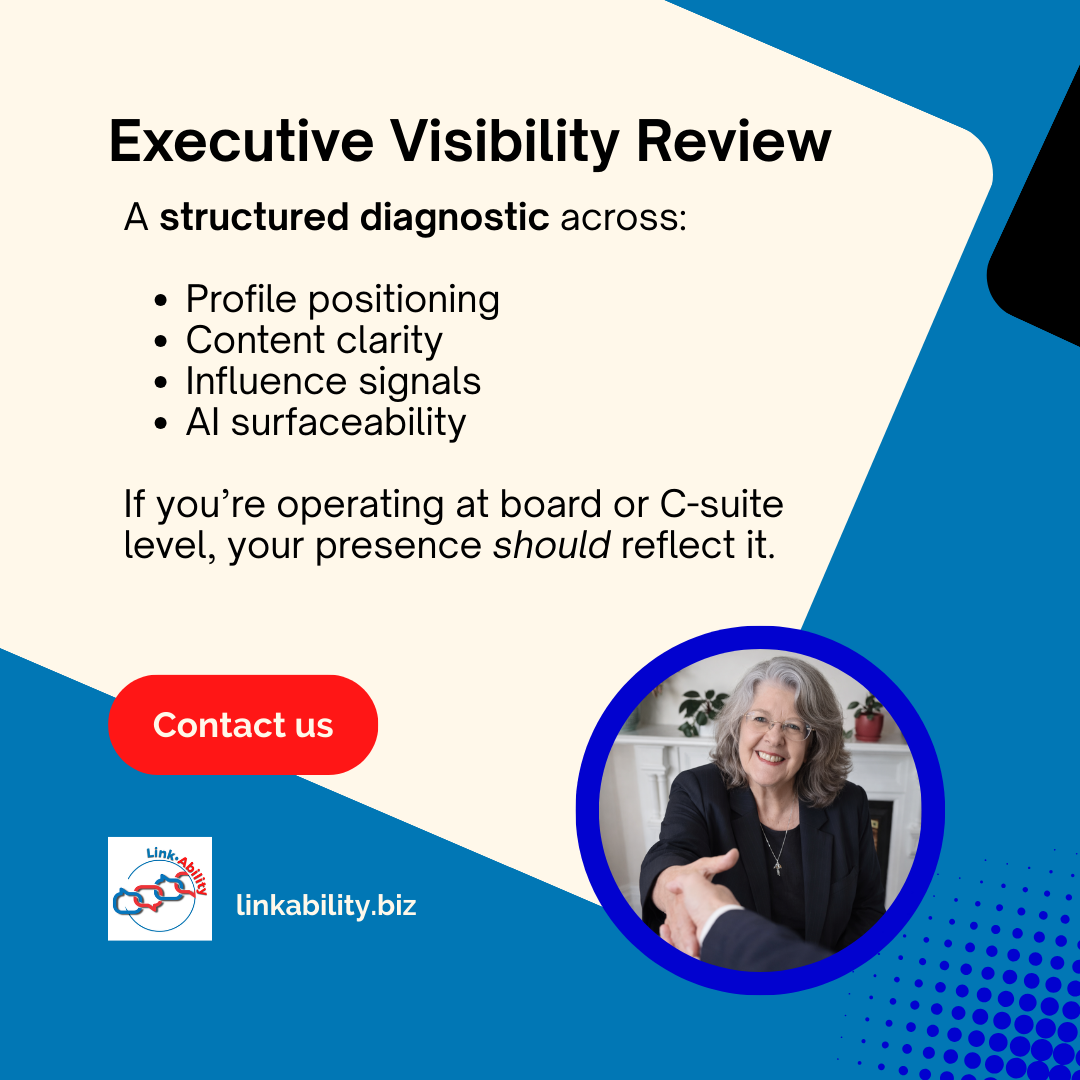
AI systems increasingly rely on digital signals to determine which individuals are surfaced as credible sources of expertise. Activity on professional platforms now plays a role in how individuals are discovered.
This means that leaders who remain silent online risk becoming less visible to both people and AI systems.
In the past, reputation was often built primarily through internal influence and industry networks. Today it also has a digital dimension. Visibility and credibility are becoming increasingly interconnected.
Commenting as a Form of Executive Listening
One of the simplest ways leaders can demonstrate listening in digital environments is through thoughtful commenting.
A well-considered comment shows that a leader has taken the time to read, reflect and respond to another perspective. It can extend a conversation, add context or connect an idea to broader experience.
During the discussion, one participant shared an example where a comment on a senior executive’s LinkedIn post triggered a broader internal conversation within the organisation. Employees observed the exchange and began discussing the issue themselves.
This illustrates how influence often emerges through small, visible interactions rather than formal announcements.

Listening and Trust
Another consistent theme throughout the discussion was the relationship between listening and trust.
People often feel heard long before they feel persuaded. When leaders demonstrate that they have absorbed perspectives and reflected on feedback, it creates a sense of respect and inclusion.
Trust grows when people see that their ideas have been acknowledged and that feedback can influence decisions.
Leaders who demonstrate listening behaviour consistently – both internally and externally – strengthen their credibility over time.
Practical Ways Leaders Can Demonstrate Listening
Senior leaders frequently say they lack the time required to produce regular content on LinkedIn.
That concern is understandable. However, participation does not necessarily require creating original posts.
Leaders can demonstrate listening through small, consistent actions such as commenting thoughtfully on posts within their field, resharing ideas and adding their own perspective, recognising the achievements of colleagues and responding to discussions where their experience adds value.
These actions demonstrate presence and perspective without requiring large amounts of time.
Leadership Visibility in the AI Era
Leadership visibility is evolving.
As professional conversations increasingly take place in digital spaces, listening is no longer a private activity. It can be observed through the way leaders engage in public dialogue.
Executives who demonstrate curiosity, openness and thoughtful engagement are often the ones who build the strongest reputations over time.
Listening, it turns out, is not simply a communication skill.
It is a leadership strategy.
Read more:
LinkedIn Engagement Strategy 2026 – Why Comments Now Drive Visibility